Pick your inputs
Interests, build time, ambition, and tools. Or describe it in a sentence.
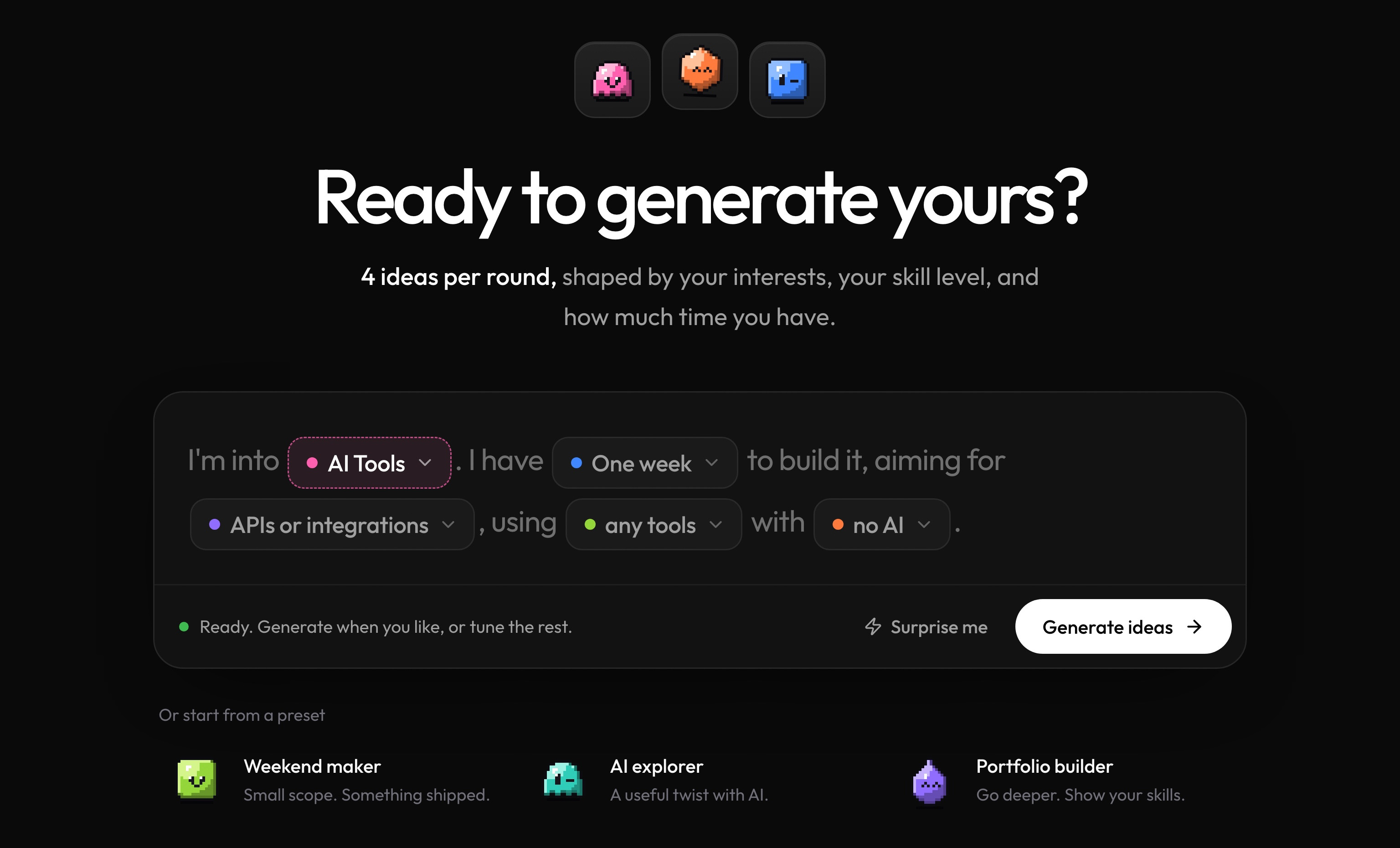
Pick your interests, time, and tools, and get four app ideas, each with a pitch, a stack, and a reason it is worth building now.
ExampleFreelancing, a weekend, ReactInvoice Nudge: a follow-up tracker for unpaid invoices
The short answer, then what makes this one different.
An app idea generator suggests software projects you could build. Vibe Code Vibes is a free one made for vibe coding: you choose your interests, how much time you have, how ambitious to be, and which tools you use, and it returns four app ideas sized to fit, each with a pitch, features, and a suggested stack.
Most idea lists are written once and go stale. These are generated from what builders are shipping and asking for this week, read daily from GitHub, Product Hunt, Hacker News, Dev.to, Hugging Face, npm, and PyPI, so every idea comes with a reason it is worth building now.
When one clicks, save it. It becomes a project with a step-by-step build plan and a prompt you can paste into Claude, Cursor, Codex, Bolt, or Replit, so the gap between the idea and the first working screen is a few minutes.
It suits beginners and weekend builders as much as experienced developers: ask for an evening-sized idea on a simple stack, or for something portfolio-scale.
A few answers in, four ideas out.
Interests, build time, ambition, and tools. Or describe it in a sentence.
Each with a pitch, key features, a build time, and a stack.
Every idea points to what is trending on GitHub, Product Hunt, and more.
It becomes a project with a build plan and a prompt to export. Not sure which tool to build it in? Take the quiz.
Not from a model's memory. Every morning we read 7 public sources for what builders are starring, launching, asking for and installing, then write your ideas from that snapshot.
A new snapshot each day, so ideas follow what is moving this week, not what a model remembers from its training.
Each source is ranked on its own terms, looking for what is rising fast rather than what is already huge.
Every idea names the signals behind its why-now, and we check them against the snapshot, so it never cites a trend that is not there.
Your interests, time and tools decide what it reaches for, and ideas you have already seen or saved are left out.
FAQ
Quick answers to the usual questions.